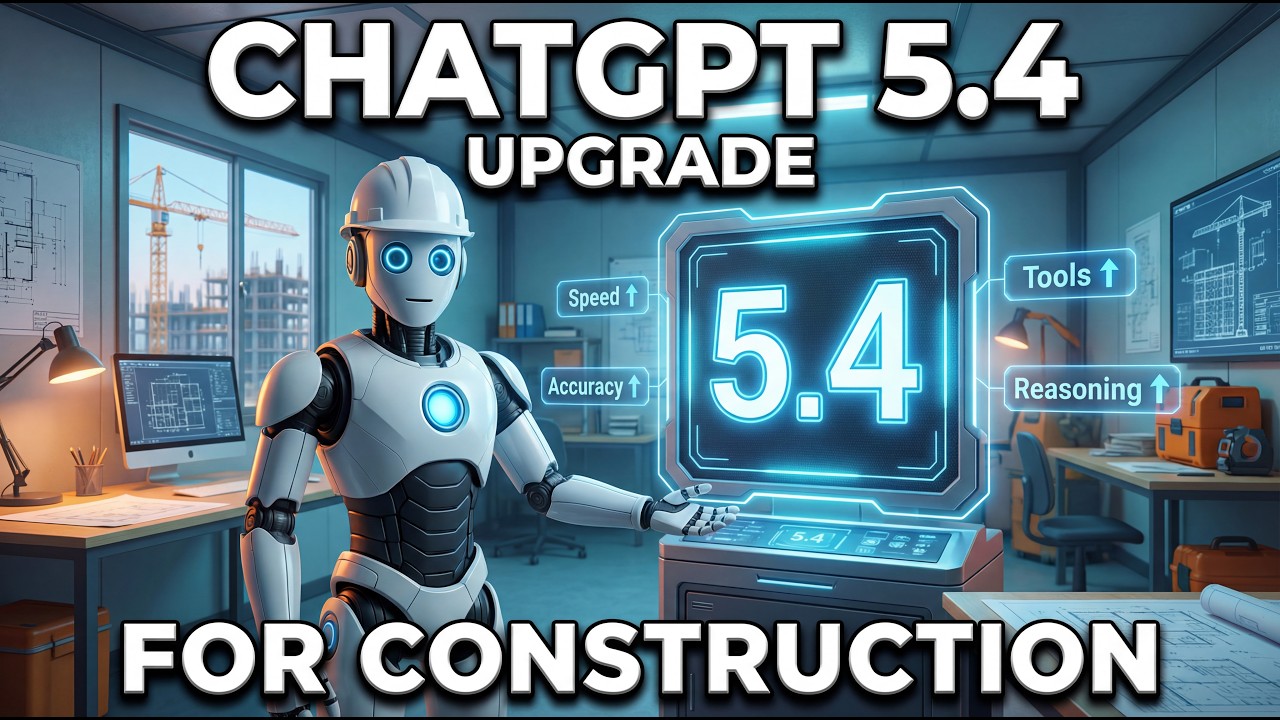
Watch the full breakdown: ChatGPT 5.4 for Construction Teams
What’s New in ChatGPT 5.4 for Construction Teams
ChatGPT 5.4 isn’t a revolutionary leap, it’s an incremental upgrade that happens to hit the exact pain points construction professionals deal with daily. The headline improvements are better reasoning on complex documents, improved context handling for long-form content, and more reliable output formatting.
For construction teams, this translates to tangible workflow improvements. The upgraded reasoning engine handles multi-page contracts with significantly fewer hallucinations. When you upload a 60-page subcontract agreement and ask about indemnification flow-downs, 5.4 actually tracks the clause references across sections instead of losing context halfway through.
The context window improvements matter most for prime contractors managing large document sets. Previous versions struggled when you loaded multiple specs, contracts, and addenda into a single conversation. Version 5.4 maintains coherence across much larger document sets, critical when you’re cross-referencing a prime contract against three subcontract agreements and a stack of change orders.
Output formatting is the quiet upgrade that saves the most time. Construction professionals need structured output, tables, checklists, formatted summaries. Version 5.4 produces cleaner markdown tables and more consistent formatting when you ask for contract comparison matrices or compliance checklists.
How Construction Professionals Should Use ChatGPT 5.4
The most effective construction use cases for ChatGPT 5.4 fall into four categories: contract review, scope writing, RFI responses, and daily briefings.
Contract review is where 5.4 shines brightest. Upload a subcontract, enable thinking mode, and ask targeted questions: “What are the liquidated damages provisions?” or “Identify all clauses that shift risk to the subcontractor.” The improved reasoning engine catches nuances that earlier versions missed, like conditional indemnification clauses buried in exhibit attachments.
Scope writing benefits from 5.4’s better understanding of construction-specific language. Feed it a set of plans and specs (or describe them in detail), and it can generate draft scope language that’s surprisingly close to what an experienced PM would write. It won’t replace your judgment on inclusions and exclusions, but it gets you to a first draft much faster.
RFI responses are another high-value use case. Paste the RFI question, provide relevant spec sections, and let ChatGPT draft a response. The key is providing context, the more project-specific data you connect, the better the output. Teams using connectors to link their project data get dramatically better results than those copying and pasting into a blank chat.
Daily briefings round out the practical applications. Ask ChatGPT to summarize yesterday’s project emails, flag action items, and draft a daily report. This is where connecting your Gmail or Outlook makes the biggest difference, turning a 30-minute morning routine into a 5-minute review.
ChatGPT 5.4 vs Claude for Construction Document Management
Let’s be honest about the competitive landscape. Both ChatGPT 5.4 and Claude (particularly Claude with its agentic capabilities) are viable options for construction teams. The right choice depends on your workflow.
ChatGPT 5.4 advantages:
- Better for quick, one-off tasks, contract clause lookup, scope language generation, email drafting
- Stronger ecosystem of plugins and integrations
- More intuitive interface for non-technical users
- Superior at structured output (tables, checklists, formatted reports)
Claude advantages:
- Ahead on agentic features. Claude can take multi-step actions, not just answer questions
- Better at maintaining context across very long conversations
- Stronger reasoning on ambiguous contract language
- CoWork features enable collaborative AI workflows for teams
For construction document management specifically, neither ChatGPT nor Claude replaces a purpose-built contract lifecycle management platform. General AI tools are excellent for analysis and drafting, but they don’t handle automated compliance tracking, deadline monitoring, or workflow orchestration.
The practical recommendation: use ChatGPT 5.4 for quick daily tasks (email drafting, RFI responses, scope writing), use Claude for deep contract analysis and agentic workflows, and use a construction-specific platform for end-to-end contract lifecycle management.
Industry leaders like ENR and AGC continue to track how AI adoption is reshaping construction operations, and the consensus is clear: the firms that integrate AI into their daily workflows now will have a significant competitive advantage by 2027.
Practical Construction AI Tools: Beyond the Chatbot
Here’s the reality that most “AI for construction” content won’t tell you: ChatGPT and Claude are general-purpose tools. They’re incredibly powerful, but they don’t understand your COI tracking workflow, your certified payroll requirements, or your subcontractor compliance deadlines.
Purpose-built construction AI tools like Contracts Connected handle what general chatbots can’t:
- COI automation: automatically monitoring certificate expiration dates, flagging non-compliant policies, and triggering renewal requests
- Certified payroll processing: validating wage rates against prevailing wage requirements and flagging discrepancies before submission
- Contract lifecycle management: tracking every contract from creation through execution, compliance monitoring, and closeout
- Compliance workflow automation: routing documents for approval, tracking deadline compliance, and generating audit-ready reports
The distinction matters because construction contract administration isn’t a conversation, it’s a system. You don’t need AI to chat about your contracts. You need AI that monitors your contracts, flags issues proactively, and takes action within permission-gated workflows.
The AI employee model represents where construction AI is heading. Instead of tools you query, you get autonomous agents that monitor your inbox, process incoming documents, track compliance deadlines, and surface exceptions for human review. That’s fundamentally different from asking ChatGPT to summarize a contract.
The bottom line: Use ChatGPT 5.4 for what it’s good at, analysis, drafting, quick lookups. Use purpose-built construction AI tools for what they’re good at, automation, compliance, and workflow management. The most effective construction teams in 2026 are using both.
Frequently Asked Questions
Is ChatGPT 5.4 good for construction contract management?
Yes. ChatGPT 5.4 excels at contract review, clause analysis, and drafting assistance. The improved reasoning engine handles complex multi-page contracts with better accuracy than previous versions. However, for full contract lifecycle management, including compliance tracking, automated workflows, deadline monitoring, and audit trails, purpose-built CLM platforms like Contracts Connected deliver more comprehensive automation that a general chatbot can’t match.
What are the best construction AI tools in 2026?
The leading construction AI tools in 2026 include ChatGPT and Claude for general document analysis and drafting, Contracts Connected for contract lifecycle management and compliance automation, plus specialty tools for estimating, scheduling, and safety management. The best choice depends on your specific workflow needs. Most high-performing construction teams use a combination of general AI tools and purpose-built platforms.
Can ChatGPT replace construction document management software?
No. ChatGPT is excellent for analyzing, summarizing, and drafting construction documents on demand. But it cannot replace purpose-built document management systems that handle version control, automated routing, compliance tracking, and audit-ready record keeping. The best approach is using ChatGPT for on-demand analysis alongside a CLM platform for workflow automation and compliance management.
How do I use ChatGPT for construction contract review?
Upload the contract to ChatGPT 5.4, enable thinking mode for deep analysis, and ask targeted questions about risk clauses, indemnification language, flow-down provisions, and payment terms. For best results, provide context about your role (prime contractor, sub, or owner) so the AI can tailor its analysis to your perspective. Cross-reference findings against your standard contract templates and always have legal counsel review AI-generated analysis before making contractual decisions.
What’s the difference between ChatGPT and construction-specific AI?
ChatGPT is a general-purpose language model, it understands language and can analyze any document you provide. Construction-specific AI tools like Contracts Connected are purpose-built to understand COIs, lien waivers, certified payroll, compliance workflows, and contract lifecycle management. Think of it this way: ChatGPT is a Swiss Army knife that can do many things well. Construction AI is the power tool designed for one job and built to do it better than anything else.